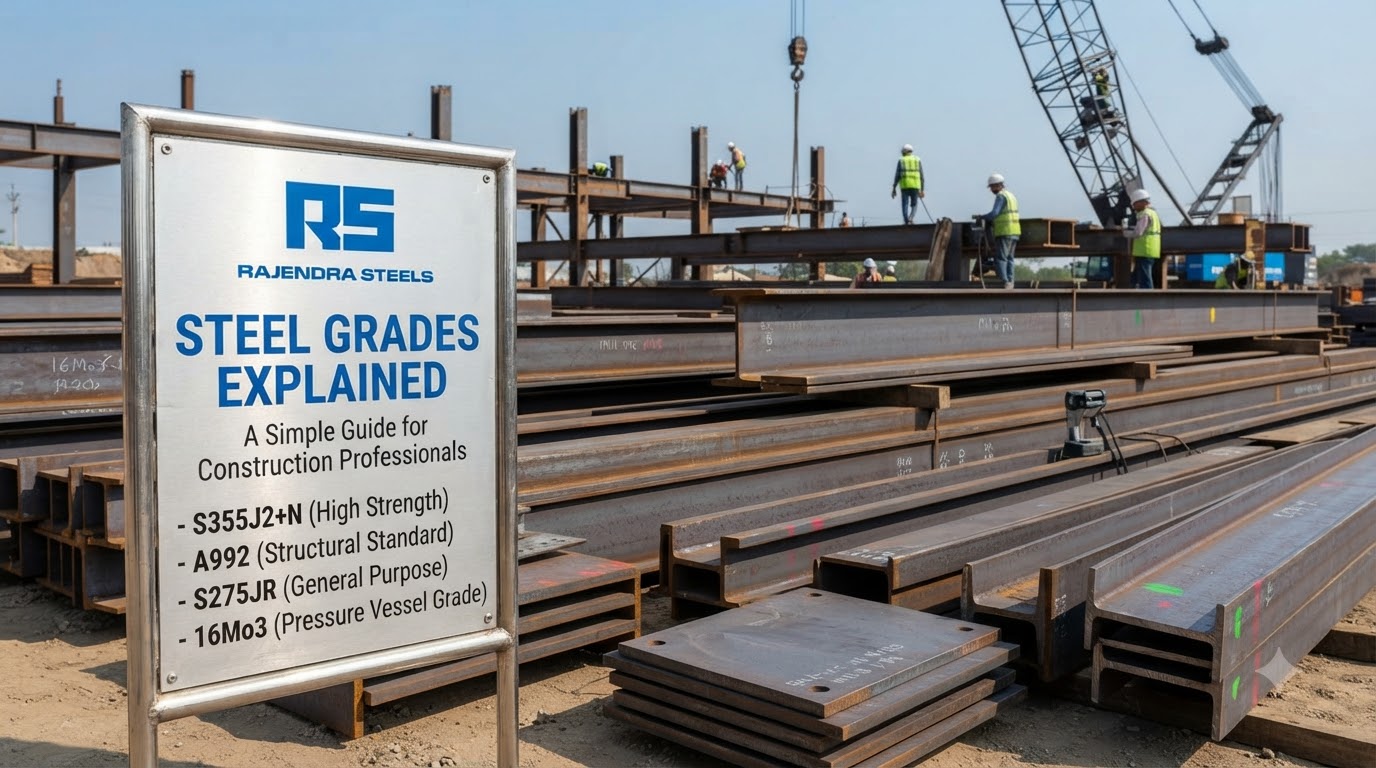
For construction professionals, understanding steel grades explained for construction does not mean memorizing every standard or grade available in the market. It means knowing how steel grades are classified, what their properties indicate, and how to select a suitable material for a specific application.
Whether you are working on structural frameworks, industrial buildings, roofing, fabrication, infrastructure, or general engineering projects, the right steel grade can contribute to reliable performance and efficient fabrication.
What Is a Steel Grade?
A steel grade is a defined classification used to identify the chemical composition, mechanical properties, manufacturing requirements, or performance characteristics of a particular steel product.
Different standards and specifications classify steel in different ways. A grade may indicate requirements related to:
- Yield strength
- Tensile strength
- Carbon content
- Alloying elements
- Ductility
- Toughness
- Weldability
- Corrosion resistance
- Surface and dimensional requirements
It is important to remember that a steel grade is not simply a measure of whether one steel is “better” than another. The appropriate grade depends on the intended application and applicable specification.
Why Steel Grades Matter in Construction
Construction projects place different demands on steel. A material used for a structural beam may have different requirements from steel used for roofing, cladding, machinery, or precision fabrication.
Selecting the appropriate grade can help ensure that the material provides the required:
Strength: The steel needs to withstand the expected loads.
Ductility: Adequate ductility can allow steel to deform before failure under appropriate conditions.
Weldability: Steel used in welded structures needs to be compatible with the specified welding process.
Formability: Sheets and coils used for bending or forming need suitable forming characteristics.
Durability: Environmental exposure and application requirements can influence the need for coatings or corrosion-resistant materials.
For this reason, construction professionals should select steel based on engineering requirements rather than choosing a grade solely because it has a higher strength value.
Common Categories of Steel Used in Construction
Steel products used in construction can broadly be grouped according to their composition, processing method, and intended application.
1. Mild and Low-Carbon Steel
Low-carbon steels contain relatively low levels of carbon and are commonly used where good weldability and formability are required.
They can be found in applications such as:
- Structural components
- Fabricated frames
- General engineering
- Plates and sheets
- Brackets and supports
- General fabrication
Their combination of strength, ductility, and workability makes low-carbon steel useful for many general-purpose applications.
2. High-Strength Structural Steel
High-strength structural steels are designed to provide higher strength than conventional structural grades.
They may be selected for structures where reducing material weight while maintaining required structural performance is beneficial.
Applications can include:
- Bridges
- Industrial structures
- Heavy construction
- Large structural frameworks
- Infrastructure projects
However, higher strength does not automatically make a grade suitable for every construction project. Welding, toughness, design requirements, and applicable standards must also be considered.
3. Stainless Steel
Stainless steel contains sufficient chromium to provide enhanced corrosion resistance through the formation of a passive surface layer.
Different stainless steel families and grades offer different combinations of corrosion resistance, strength, formability, and temperature performance.
Common applications include:
- Architectural components
- Food-processing facilities
- Industrial equipment
- Railings and fittings
- Commercial buildings
- Areas exposed to corrosive environments
Grades such as 304 and 316 are widely recognized stainless steel grades, but the correct choice depends on the environment and application.
4. Galvanized Steel
Galvanized steel is steel protected with a zinc coating. One common production method is hot-dip galvanizing, where steel is passed through molten zinc to form a protective coating.
The zinc coating provides sacrificial protection and helps improve resistance to atmospheric corrosion.
Galvanized steel is commonly used for:
- Roofing
- Wall cladding
- Construction components
- Ducting
- Automotive parts
- General fabricated products
The required coating thickness and specification should be selected according to the exposure conditions and project requirements.
Steel Grades and Standards
One of the most important points when comparing steel grades is the standard under which the material is specified.
Construction professionals may encounter standards from organizations and systems such as:
- BIS/IS standards in India
- ASTM standards
- EN standards
- JIS standards
- ISO standards
The designation of a grade can therefore vary between standards. Two products with similar applications should not automatically be treated as identical simply because their names appear similar.
Always check the applicable specification, grade designation, mechanical properties, dimensions, and certification requirements before purchasing.
Steel Grade Comparison for Construction
The following table provides a simplified overview of major steel categories. It is intended as a general guide rather than a substitute for project specifications or engineering calculations.
| Steel Category | Key Characteristics | Typical Construction Uses | Main Consideration |
| Low-carbon steel | Good weldability and formability | General fabrication, structural components | Suitable grade and strength requirements |
| Structural steel | Designed for structural performance | Buildings, frames, infrastructure | Yield strength and design specification |
| High-strength steel | Higher strength-to-weight potential | Heavy structures, infrastructure | Welding, toughness and design requirements |
| Stainless steel | High corrosion resistance | Architecture, equipment, exposed components | Environment and stainless grade |
| Galvanized steel | Zinc-coated corrosion protection | Roofing, cladding, fabricated components | Coating specification and exposure |
How to Choose the Right Steel Grade
When selecting steel for a construction project, consider the complete application rather than focusing on a single property.
1. Determine the Required Strength
Start with the project’s structural and engineering requirements. Yield strength and tensile strength can be important factors in selecting structural materials.
2. Consider Welding Requirements
If the steel will be welded, its chemical composition and applicable specification should be compatible with the intended welding procedure.
3. Evaluate Formability
Sheets and coils that will be bent, pressed, stamped, or formed may require a grade with appropriate ductility and forming characteristics.
4. Consider the Environment
Outdoor, coastal, industrial, humid, or chemically exposed environments can require greater attention to corrosion protection.
This may involve selecting an appropriate stainless steel grade, galvanized product, coating system, or other corrosion-control approach.
5. Check Dimensions and Tolerances
The correct grade is only part of the purchasing decision. Thickness, width, length, flatness, surface condition, and dimensional tolerances also need to meet project requirements.
6. Verify Documentation
For important construction and industrial applications, buyers should verify relevant mill certificates, inspection documents, test results, and applicable standards as required by the project.
Why Work With a Trusted Steel Manufacturer in India?
For construction companies and fabricators, reliable sourcing is about more than obtaining steel at a competitive price.
A trusted steel manufacturer in India or supplier should be able to help customers identify suitable products based on:
- Steel grade
- Product type
- Thickness and width
- Application
- Quality requirements
- Delivery requirements
- Relevant documentation
Consistent material quality is particularly important when steel is being used across large construction projects where variations in material properties or dimensions can affect fabrication and project efficiency.
Choosing a Leading Steel Supplier in India
A leading steel supplier in India should offer a combination of product knowledge, reliable sourcing, quality-focused processes, and dependable customer service.
Before placing an order, construction professionals should ask:
- Does the product meet the required standard?
- Is the exact grade available?
- Are the required dimensions available?
- Can the supplier provide relevant quality documentation?
- Is the material suitable for welding or forming?
- Does the supplier understand the project’s application?
- Can the required quantity and delivery schedule be supported?
Rajendra Steels supplies steel products including Hot Rolled Coils, Cold Rolled Coils, galvanized products, and stainless steel sheets and coils. For buyers in Delhi and across India, selecting a supplier based on product suitability, quality requirements, and dependable service is essential.
Frequently Asked Questions About Steel Grades
1. What does a steel grade mean?
A steel grade identifies a material according to a particular standard or specification. It can define requirements such as chemical composition, mechanical properties, dimensions, and other characteristics.
2. Which steel grade is best for construction?
There is no single steel grade that is best for every construction project. The appropriate grade depends on structural loads, design requirements, welding, forming, environmental exposure, applicable standards, and other project specifications.
3. What is the difference between steel grade and steel type?
A steel type generally describes a broader category or material family, while a grade provides a more specific classification under a particular standard or specification.
4. Is higher-strength steel always better?
No. Higher strength can be beneficial for certain applications, but other factors such as ductility, toughness, weldability, formability, corrosion resistance, availability, and cost must also be considered.
5. How do I verify a steel grade?
Check the product designation and applicable standard, and request relevant material test certificates or quality documentation from the supplier when required.
6. What steel is commonly used for general fabrication?
Low-carbon and mild steels are widely used for general fabrication because they can provide a useful combination of strength, weldability, and formability. The exact grade should still be selected according to the application.
7. Is stainless steel suitable for construction?
Yes. Stainless steel is used in many construction and architectural applications, particularly where corrosion resistance, appearance, durability, or hygiene is important. The appropriate stainless steel grade depends on the environment and required performance.
Conclusion
Understanding steel grades explained for construction helps professionals make better material-selection decisions. Instead of choosing steel based only on strength or price, construction teams should consider the complete set of requirements, including grade, standard, mechanical properties, weldability, formability, corrosion protection, dimensions, and documentation.
For contractors, engineers, fabricators, and procurement teams, working with a reliable supplier can also simplify the process of identifying and sourcing the right material.
Whether the requirement involves structural steel, hot rolled coils, cold rolled coils, galvanized steel, or stainless steel, the best choice is the material that meets the project’s technical requirements and applicable standards.