Key Takeaways
- HR coils are rolled at high temperature (above 900°C) and cooled at room temperature; CR coils are HR coils rolled again at ambient temperature for extra precision.
- HR coils are cheaper per tonne and suit structural, heavy engineering, and pipe/tube applications.
- CR coils offer a smoother surface, tighter thickness tolerance (±0.01–0.05 mm), and better formability for deep-drawing and precision parts.
- HR coils typically range from 1.2 mm to 25 mm thickness; CR coils are generally 0.12 mm to 3 mm.
- CR coils cost 10–20% more than HR coils of comparable grade due to the additional rolling, annealing, and pickling processes.
- Key BIS standards: IS 2062 (HR structural steel), IS 1079 (HR sheets/strips), IS 513 (CR carbon steel CRCA), IS 10748 (HR strip for pipes).
- HR coils carry visible scale/oxide layer; CR coils have a clean, oil-coated, ready-to-paint surface.
- Wrong selection e.g., using HR where tight tolerance is needed causes fitment issues, higher rejection rates, and rework costs.
- Both types require dry, elevated, moisture-free storage to prevent rust and scale-related quality loss.
CR Coils are HR Coils Featured Snippet Answer
Every steel buyer eventually faces the same question at the procurement counter: “Should I order HR coils or CR coils?” Get it wrong, and the consequences show up fast — panels that don’t fit, welds that crack under stress, surfaces that need extra finishing, or a budget that quietly overshoots because you paid for precision you didn’t need.
The difference between HR and CR coils isn’t just technical jargon it directly affects cost, structural safety, surface quality, and how well the material performs in your specific application. A contractor building a warehouse frame has very different needs from a fabricator making kitchen appliances or a distributor supplying automotive part-makers.
In this guide, we break down exactly how hot rolled and cold rolled steel coils are made, where each one performs best, their composition and mechanical properties, BIS/IS standards that apply in India, common buying mistakes, and a practical selection framework so you can order the right coil the first time.
CR Coils are HR Coils Definition
In Simple Terms
Think of steel coil-making like baking and then finishing a metal sheet:
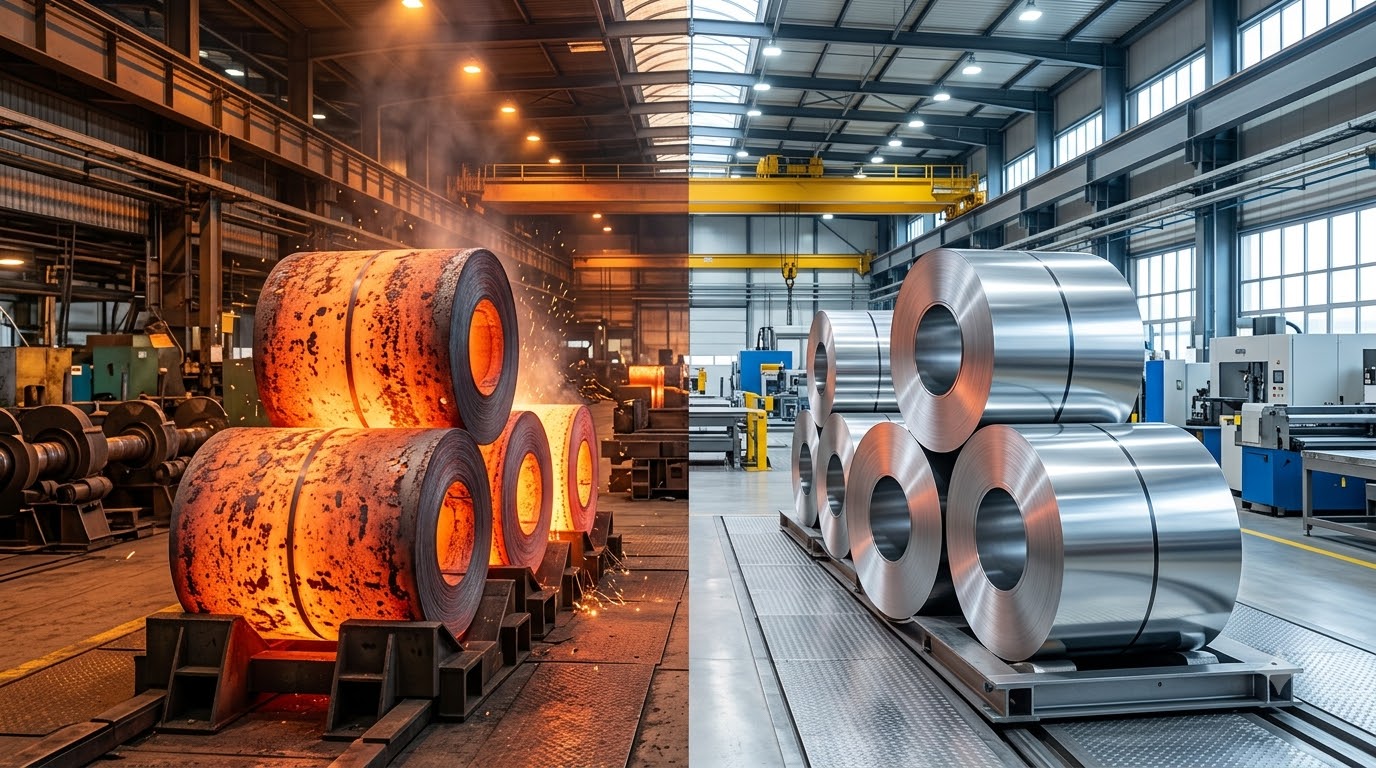
- Hot Rolled (HR) coil: A steel slab is heated above 900°C (well above the point where steel recrystallizes) and rolled into thin, long coils while still hot. It’s then air-cooled. The result is a slightly rough, scaled surface with looser dimensional tolerance but it’s fast to produce and economical.
- Cold Rolled (CR) coil: This starts as an HR coil that is pickled (acid-cleaned to remove scale) and then rolled again at room temperature. Rolling steel when it’s cold work-hardens it, so CR coils are usually annealed afterward to restore ductility. The output is a smooth, shiny, precise-gauge coil.
In Technical/Metallurgical Terms
Hot rolling occurs above the steel’s recrystallization temperature, allowing grains to continuously reform and refine during deformation this relieves internal stress and keeps the material relatively ductile despite heavy reduction in thickness. The rapid air-cooling after rolling forms an oxide (mill scale) layer and leads to wider dimensional tolerances due to thermal contraction variance.
Cold rolling is performed below the recrystallization temperature, which causes strain hardening (work hardening) — grains elongate and dislocation density increases, raising tensile and yield strength but reducing ductility. This is why CR coils typically undergo annealing (controlled reheating) to restore formability before use, followed by temper rolling for surface finish and flatness control.
CR Coils are HR Coils Benefits
Benefits of Hot Rolled (HR) Coils
Cost-Effective for Bulk Structural Use
HR coils require fewer processing steps, making them significantly cheaper per tonne ideal for large-volume structural and industrial projects.
Higher Thickness Range
HR coils are available in thicker gauges (up to 25 mm+), suited for load-bearing members, heavy machinery bases, and pipe manufacturing.
Easier to Weld and Fabricate
The coarser grain structure and moderate hardness make HR steel easier to cut, weld, and shape on-site without specialized equipment.
Good Dimensional Flexibility for Rough Applications
Where exact tolerance isn’t critical (e.g., structural framing, agricultural equipment), HR’s slightly looser tolerance is a non-issue and saves cost.
Benefits of Cold Rolled (CR) Coils
Superior Surface Finish
CR coils have a smooth, clean, oil-coated surface ideal for painting, plating, or exposed applications without extra surface prep.
Tighter Dimensional Tolerance
Precision tolerances (as tight as ±0.01 mm) make CR coils essential for parts requiring exact fitment, such as automotive panels and enclosures.
Better Formability for Deep Drawing
Annealed CR steel has excellent ductility, allowing complex shapes, deep draws, and sharp bends without cracking.
Higher Strength-to-Thickness Ratio
Work hardening during cold rolling raises yield strength, allowing thinner CR sheets to match the strength of thicker HR sheets in some designs.
Types
Both HR and CR coils come in multiple grades and product forms depending on end use.
| Type | Description | Typical Application |
| HR Structural Coils (IS 2062) | General structural grade, moderate strength | Building frames, trusses, brackets |
| HR Pipe-Making Strips (IS 10748) | HR strip specifically for ERW pipe/tube manufacturing | Water pipes, scaffolding tubes, structural pipes |
| HR Sheets & Strips (IS 1079) | General-purpose HR flat product | Chassis, containers, general fabrication |
| CRCA Coils (IS 513) | Cold Rolled Close Annealed standard CR grade | Automotive panels, almirahs, home appliances |
| CR Deep Drawing Quality (DDQ) | High-formability CR grade | Sinks, cookware, deep-drawn components |
| Galvanized/Coated Coils (HR or CR base) | Zinc-coated for corrosion resistance | Roofing, outdoor structures, HVAC ducting |
Composition / Specifications
Typical Chemical Composition (Mild Steel Base Grades)
| Element | HR Coil (IS 2062, Grade E250) | CR Coil (IS 513, CR2/CR4) |
| Carbon (C) | ≤ 0.22% | ≤ 0.12% |
| Manganese (Mn) | ≤ 1.5% | ≤ 0.60% |
| Sulphur (S) | ≤ 0.045% | ≤ 0.035% |
| Phosphorus (P) | ≤ 0.045% | ≤ 0.035% |
| Silicon (Si) | ≤ 0.4% | ≤ 0.10% |
Mechanical Properties
| Property | HR Coil (IS 2062 E250) | CR Coil (IS 513 CR2) |
| Yield Strength | ≥ 250 MPa | ≥ 210 MPa (varies by temper) |
| Tensile Strength | 410–560 MPa | 270–410 MPa |
| Elongation (min.) | 23% | 28–34% |
| Surface Hardness | Moderate | Lower (post-anneal), higher if temper-rolled |
| Thickness Range | 1.2 mm – 25 mm | 0.12 mm – 3 mm |
| Tolerance | ±0.10 – 0.30 mm | ±0.01 – 0.05 mm |
Purpose and Suitability
- HR E250/E350 grades: Structural framing, beams, columns, heavy equipmen where strength matters more than surface finish.
- CR2 (commercial quality): General panel work, cabinets, and light enclosures.
- CR4/DDQ (deep drawing quality): Automotive body panels, LPG cylinders, and appliances needing complex forming.
Comparison Tables
HR Coils vs CR Coils — At a Glance
| Parameter | Hot Rolled (HR) Coils | Cold Rolled (CR) Coils |
| Processing Temperature | Above recrystallization (~900°C+) | Room temperature (after HR base) |
| Surface Finish | Rough, scaled, matte | Smooth, shiny, clean |
| Dimensional Tolerance | Looser (±0.10–0.30 mm) | Tighter (±0.01–0.05 mm) |
| Thickness Range | 1.2 mm – 25 mm | 0.12 mm – 3 mm |
| Cost per Tonne | Lower | 10–20% Higher |
| Formability | Moderate | High (post-annealing) |
| Weldability | Excellent | Good, needs cleaner prep |
| Typical Use | Structural, pipes, heavy fabrication | Automotive, appliances, precision parts |
| Corrosion Resistance (bare) | Lower (scale layer, but thicker section) | Lower (thin gauge, needs coating) |
Price vs Performance Snapshot
| Factor | HR Coils | CR Coils |
| Upfront Material Cost | Lower | Higher |
| Additional Finishing Cost | May need surface cleaning/grinding | Usually ready-to-use |
| Long-term Value (structural use) | High (strength per rupee) | Not applicable — wrong use case |
| Long-term Value (precision parts) | Poor fit, high rejection risk | High (fewer rejects, better fit) |
Selection / Usage Guide
Step 1: Identify the Application Category
- Structural/load-bearing (columns, beams, trusses) → HR coils
- Precision sheet metal (panels, enclosures, appliances) → CR coils
- Pipes/tubes → HR strip (IS 10748)
- Outdoor exposed structures → HR or CR with galvanizing/coating
Step 2: Check Thickness Requirement
If your design needs thickness above 3 mm, HR is usually the only practical option since CR coils rarely exceed 3 mm.
Step 3: Evaluate Surface Finish Needs
If the final product will be painted, chrome-plated, or visually exposed without heavy surface prep, choose CR.
Step 4: Assess Forming Complexity
Deep draws, sharp folds, or complex curves need CR’s higher ductility. Simple cuts and welds work fine with HR.
Step 5: Balance Budget vs Precision
Don’t over-specify. Using CR coils for rough structural work wastes money; using HR coils for precision parts risks poor fitment and rejects.
Application-Wise Quick Guide
| Application | Recommended Coil |
| Building/warehouse structural frame | HR (IS 2062) |
| Water/scaffolding pipes | HR strip (IS 10748) |
| Car body panels | CR (DDQ grade) |
| Home appliances (washing machines, almirahs) | CR (CRCA) |
| Roofing sheets | HR or CR + galvanizing |
| Machine bases/heavy brackets | HR |
| Electrical panel boxes | CR |
CR Coils are HR Coils Safety & Handling Guidelines
Storage
- Store coils on raised pallets or dunnage, never directly on bare ground, to prevent moisture wicking and rust.
- Keep coils under a covered, ventilated shed exposure to rain accelerates rust, especially on CR’s thinner gauge.
- Stack coils by weight capacity ratings of the storage racks to avoid collapse.
Corrosion Prevention
- CR coils are typically oiled at the mill do not wipe this off before storage; it’s a temporary rust inhibitor, not a defect.
- HR coils naturally resist surface rust better short-term due to their scale layer, but long exposure still causes pitting.
- For coastal or high-humidity regions, pre or pre-coated variants.
Site Handling
- Use proper coil-lifting equipment (C-hooks, coil cars) never drag coils, as this damages edges and causes telescoping.
- Always de-coil on a levelled, clean surface to avoid surface scratching, especially for CR material.
- Wear cut-resistant gloves; coil edges are sharp enough to cause lacerations.
Quality-Check Precautions
- Verify the Mill Test Certificate (MTC) against the physical coil tag before acceptance.
- Check for edge waviness, camber, and uniform coil width deviations indicate rolling defects.
- For CR coils, inspect for surface scratches, roller marks, or oil staining before use in visible applications.
CR Coils are HR Coils Common Mistakes
| Mistake | Why It Happens | Correct Practice |
| Using HR coils where tight tolerance is required | Assuming “steel is steel” without checking tolerance specs | Match tolerance requirement to CR coils for precision work |
| Ordering CR coils for heavy structural use | Believing CR is “better quality” across the board | Use HR for load-bearing members; it’s stronger in thicker sections and cheaper |
| Ignoring storage conditions | Treating coils as weatherproof | Store under cover, elevated, in dry conditions |
| Skipping Mill Test Certificate verification | Time pressure during procurement | Always cross-check MTC with physical coil markings |
| Not accounting for work-hardening in CR forming | Underestimating springback during bending | Factor in annealing state and perform trial bends |
| Buying without specifying IS grade | Focusing only on price, not on formal grade/spec | Always specify IS 2062/IS 513/IS 1079 grade in the PO |
| Using bare HR/CR in coastal/humid areas without coating | Cost-cutting on coating | Opt for galvanized or pre-painted coil for corrosion-prone zones |
CR Coils are HR Coils Pros & Cons
| Type | Pros | Cons |
| HR Coils | Lower cost; wide thickness range; easy to weld/fabricate; good for heavy structures | Rougher surface; looser tolerance; needs cleaning before painting |
| CR Coils | Smooth finish; tight tolerance; excellent formability; ready for coating/plating | Higher cost; limited to thinner gauges; more sensitive to handling damage |
Latest Industry Trends / Research
- Green Steel Momentum: Indian steelmakers are increasingly investing in lower-carbon production routes (scrap-based EAF, hydrogen-blended processes) as global buyers push for reduced embodied carbon in construction materials.
- Automation in Rolling Mills: Advanced gauge-control and AI-assisted defect detection are improving tolerance consistency in both HR and CR lines, reducing rejection rates industry-wide.
- Value-Added Coated Products: Demand for pre-coated (galvanized/color-coated) coils built on both HR and CR bases continues to rise for roofing, cladding, and modular construction.
- Price Volatility: Coil prices remain sensitive to iron ore costs, coking coal imports, and global trade dynamics; buyers are advised to track monthly steel price indices before large orders rather than relying on last quarter’s rates.
- Import Substitution Push: Domestic capacity additions in HR and CR coil production are aimed at reducing reliance on imports, particularly for automotive-grade CR steel.
BIS / IS Standards & Certifications
| Standard | Applies To | Key Coverage |
| IS 2062 | Hot rolled structural steel plates, sheets, strips | Grades (E165–E450), mechanical properties, chemical limits |
| IS 1079 | Hot rolled carbon steel sheets and strips | General-purpose HR flat products |
| IS 10748 | Hot rolled steel strip for welded pipes/tubes | Pipe-making grade HR strip |
| IS 513 | Cold rolled low carbon steel sheets/strips (CRCA) | CR grades (D, EDD, CR1–CR4), tolerances |
| IS 277 | Galvanized steel sheets (plain/corrugated) | Coated HR/CR products for roofing |
| ISI Mark | Voluntary/mandatory certification mark | Confirms compliance with the relevant IS standard through BIS licensing |
Always ask your supplier for the IS grade, ISI/BIS license number, and Mill Test Certificate for every coil batch — this protects you legally and structurally, especially for government or large infrastructure projects where compliance is audited.
FAQs
- What is the main difference between HR and CR steel coils? HR coils are rolled at high temperature, giving them thicker gauges and a rougher finish at lower cost. CR coils are re-rolled at room temperature for a smoother surface, tighter tolerance, and better formability, at a higher price.
- Which is stronger, HR or CR steel? In equivalent thickness, HR generally has good baseline strength suited to structural loads. However, CR’s work-hardening can increase yield strength per unit thickness, making thin CR sheets surprisingly strong for their gauge.
- Can CR coils be used for structural construction? Technically possible for light-gauge structures, but CR’s limited thickness range (typically under 3 mm) makes it impractical for heavy structural members HR is the standard choice there.
- Why are CR coils more expensive than HR coils? CR coils go through additional processing pickling, cold rolling, annealing, and often temper rolling — which adds cost compared to the single-pass HR process.
- Is HR steel prone to rusting faster than CR steel? HR steel’s mill scale offers some short-term protection, but both types rust without proper coating or storage. Thinner CR sheets can show rust effects faster once the protective oil film wears off.
- What thickness range should I expect for HR vs CR coils? HR coils typically range from 1.2 mm to 25 mm, while CR coils are generally 0.12 mm to 3 mm — HR covers the heavier gauges, CR covers thin precision gauges.
- Do HR coils need surface treatment before painting? Yes. HR coils usually require de-scaling (pickling or shot blasting) before painting for good adhesion, unlike CR coils, which are cleaner out of the mill.
- What is CRCA steel? CRCA stands for Cold Rolled Close Annealed a standard CR coil grade under IS 513, known for good formability and surface finish, widely used in appliances and furniture.
- Which IS standard applies to structural HR coils in India? IS 2062 governs hot rolled structural steel plates, sheets, and strips, covering various strength grades like E250, E350, and E450.
- Can I use HR coil for pipe manufacturing? Yes, but pipe manufacturers typically specify HR strip under IS 10748, which is optimized for ERW (Electric Resistance Welded) pipe production.
- What causes rejection of CR coils on inspection? Common rejection causes include surface scratches, roller marks, inconsistent thickness (out of tolerance), edge waviness, and camber beyond permissible limits.
- Is galvanizing available on both HR and CR coils? Yes. Both HR and CR base coils can be hot-dip galvanized under IS 277 for enhanced corrosion resistance, commonly used in roofing and outdoor applications.
- How do I verify the authenticity of a steel coil batch? Cross-check the Mill Test Certificate (MTC) details heat number, grade, chemical/mechanical results against the physical tags on the coil, and confirm the supplier’s BIS/ISI license if applicable.
- What’s the typical elongation difference between HR and CR steel? HR steel (IS 2062 E250) typically shows around 23% minimum elongation, while annealed CR steel (IS 513 CR2) can reach 28–34%, reflecting its higher ductility.
- Can HR and CR coils be substituted for each other in a project? Generally not recommended without engineering review the mechanical properties, tolerances, and surface characteristics differ enough that substitution can compromise fit, finish, or structural performance.
People Also Ask
What does HR and CR mean in steel? HR stands for Hot Rolled and CR stands for Cold Rolled referring to the temperature at which the steel is processed during coil manufacturing.
Which is cheaper, HR or CR coil? HR coils are generally cheaper due to fewer processing steps compared to CR coils, which require additional pickling, cold rolling, and annealing.
What is CR coil used for? CR coils are used for automotive body panels, home appliances, furniture, electrical enclosures, and any application needing a smooth finish and tight dimensional tolerance.
What is HR coil used for? HR coils are used in structural construction, pipe manufacturing, heavy machinery, and general fabrication where strength and cost matter more than surface finish.
Is CR steel stronger than HR steel? Not inherently stronger in composition, but cold working increases yield strength in CR steel per unit thickness, making it efficient for thin, high-strength applications.
What is the IS code for cold rolled steel coils? IS 513 is the primary Indian Standard governing cold rolled low carbon steel sheets and strips (CRCA).
Can HR coils be converted into CR coils? Yes this is exactly how CR coils are made. HR coils are pickled to remove scale, then cold rolled and annealed to become CR coils.
Summary
Hot Rolled (HR) and Cold Rolled (CR) steel coils serve different purposes, and choosing correctly protects both your budget and your project’s structural integrity. HR coils, rolled above recrystallization temperature, offer thicker gauges, lower cost, and strong weldability making them the go-to choice for structural framing, heavy fabrication, and pipe manufacturing under standards like IS 2062 and IS 10748. CR coils, produced by further rolling HR steel at room temperature, deliver a smoother finish, tighter tolerances, and superior formability, governed by IS 513 ideal for automotive panels, appliances, and precision components.
The right choice depends on your application’s thickness needs, surface finish requirements, forming complexity, and budget. Always verify IS grade compliance, request Mill Test Certificates, and follow proper storage and handling practices to avoid corrosion and quality issues. For project-specific guidance, consulting a structural engineer or an experienced supplier remains the safest route to getting the correct coil for your job.
References
- Bureau of Indian Standards (BIS) — IS 2062: Hot Rolled Medium and High Tensile Structural Steel
- Bureau of Indian Standards (BIS) — IS 513: Cold Rolled Low Carbon Steel Sheets and Strips
- Bureau of Indian Standards (BIS) — IS 1079: Hot Rolled Carbon Steel Sheets and Strips
- Bureau of Indian Standards (BIS) — IS 10748: Hot Rolled Steel Strip for Welded Tubes and Pipes
- Bureau of Indian Standards (BIS) — IS 277: Galvanized Steel Sheets Specification
- Indian Steel Association / Ministry of Steel, Government of India — industry data and market reports
- World Steel Association — global steel production and green steel initiatives
Disclaimer
This article is intended for general educational and informational purposes only. Steel grade selection, structural design, and load calculations should always be verified by a qualified structural engineer or technical expert for your specific project. For product recommendations, technical datasheets, or custom specifications, please consult Rajendra Steels’ technical team before finalizing your order.
Looking for the right HR or CR coils for your next project? Rajendra Steels supplies BIS-certified hot rolled and cold rolled steel coils tailored to your application structural, automotive, or industrial. Contact our technical team for grade recommendations, current pricing, and bulk order support.